The short answer
Burnout is not a diagnosis and it is not a character flaw. The World Health Organization calls it an occupational phenomenon, and the dominant research model says it is what happens when the demands of a job outrun the resources behind it. At a small nonprofit that gap has a specific shape: one person holding several roles, pay set by what a board thinks a donor will tolerate, a board that may or may not help, and funding that lands least on the leaders who carry the most, who are disproportionately women and people of color. Four questions decide whether the job is survivable, one post each. And "design" implies a designer: the executive director, the board, and the funder each hold a piece, and this series says which.
The Center for Effective Philanthropy asked nonprofit CEOs this spring how concerned they were about their own burnout. Forty-six percent said "very much," up from 29 percent the year before. A seventeen-point jump in twelve months.
Here is what happened next in most of the organizations I know. Somebody proposed a wellness stipend. Somebody found a coach. Somebody reminded the executive director to take Fridays. None of it was wrong. Coaching has a decent randomized trial behind it; a stipend has no evidence at all. Neither one changes how many jobs the job is.
I ran a small organization for most of a decade. Burnout was ever-present, which led to mistakes, overlooked details I usually didn't miss, and questions about whether I was the right fit for this leadership position. I had a great team, but even a great team couldn't protect me from the reality that I was wearing too many hats and feeling isolated as I navigated a growing sense of inadequacy. I was tired in a way sleep did not fix, and the job, as I had built it, was three jobs, and that was not sustainable. I found myself in a difficult position, recognizing the precariousness of my role while being limited by the organization's size and the lack of resources to address and offset the multifaceted effects burnout was having on me.
This series is about that design at organizations with budgets under a few million dollars. Four questions, one post each. Each one has an owner.
WHAT THE WORD IS MEASURING
The World Health Organization classified burnout in 2019 as an occupational phenomenon, not a medical condition: chronic workplace stress that has not been successfully managed, showing up as exhaustion, cynicism toward the job, and reduced effectiveness. Those three come from Christina Maslach, whose inventory defined the field for decades. With Michael Leiter she named six areas of work life where burnout starts: workload, control, reward, community, fairness, and values. One of the six is about hours. The model most researchers use now, job demands and resources, says it in fewer words: burnout is what happens when what the job asks outruns what the job gives.
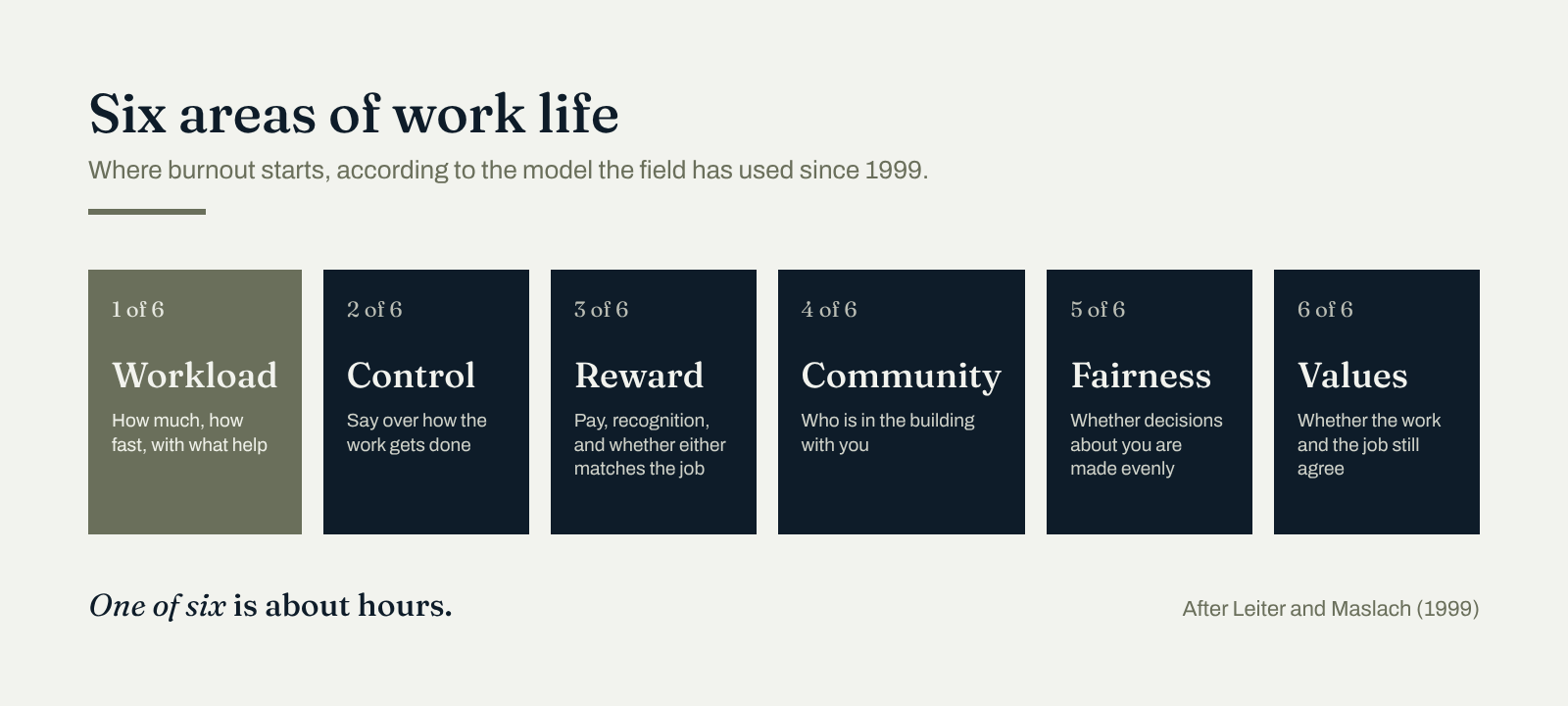
The field is not settled. Renzo Bianchi and Irvin Schonfeld have spent a decade arguing that Maslach's inventory does not measure a single thing called burnout, that what it picks up may be depression caused by work, and, in their own studies, that personality predicted burnout scores better than job conditions did. I take that seriously. I still think the job is the right place to look at a small nonprofit, for a reason the personality research cannot answer. Whoever sits in the seat is doing three jobs.
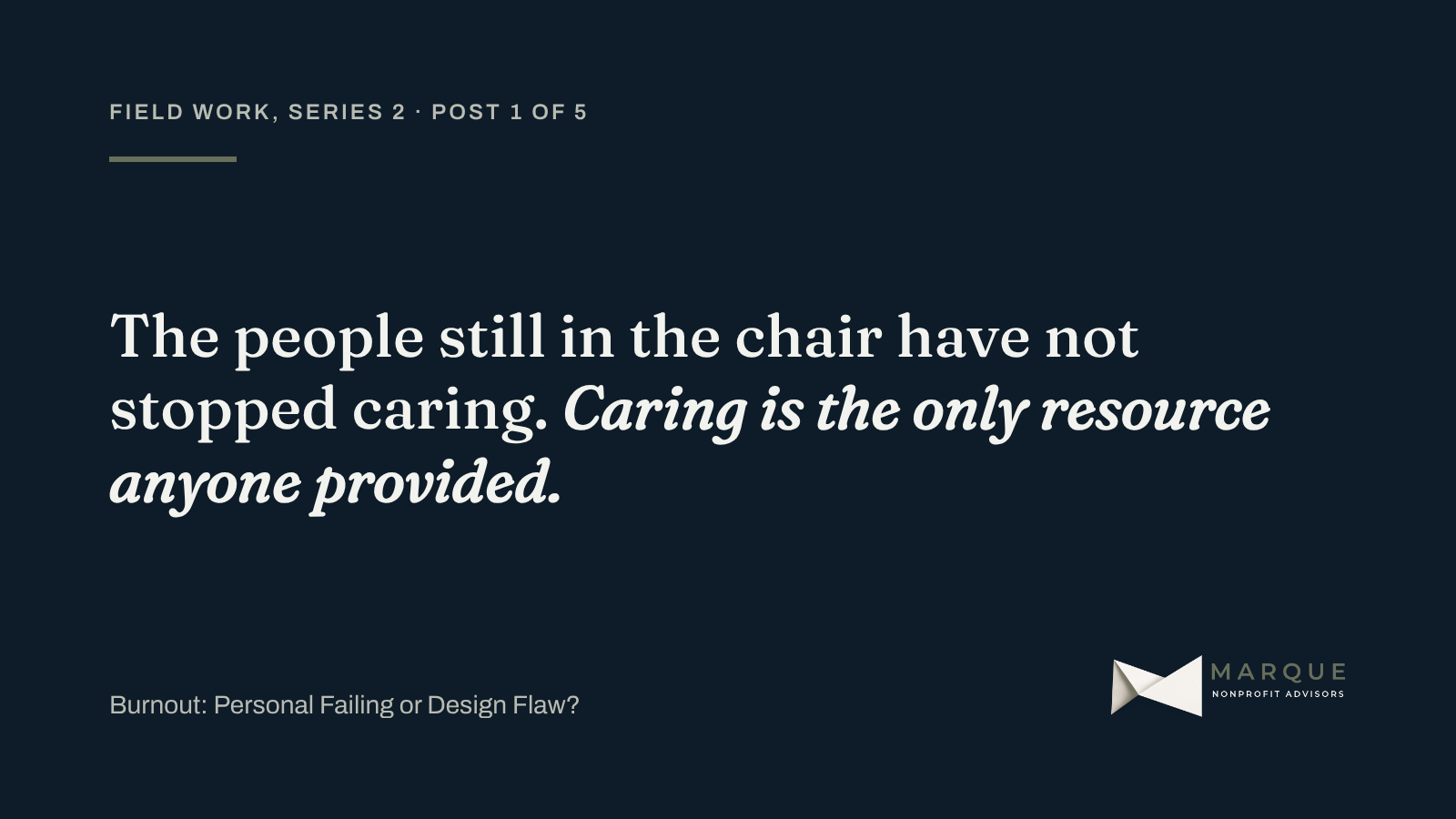
The Chronicle of Philanthropy surveyed more than 350 nonprofit CEOs in 2024. Ninety-six percent reported high job satisfaction. Eighty-eight percent said the demands were never-ending. The people still in the chair have not stopped caring. Caring is the only resource anyone provided.
HOW MANY JOBS IS THIS JOB
In that Chronicle survey, CEOs at organizations under $1 million reported less satisfaction than CEOs at $11 million and up on salary, employee effectiveness, and board support. CompassPoint's Daring to Lead study described why in 2011: organizations under 25 staff run multiple programs on multiple revenue streams and cannot afford a senior person in finance, HR, or fundraising. The executive director is the senior person in all three. Nobody has repeated that study, and nothing I have seen suggests the structure changed. At $3 million it is one development person, no CFO, and an executive director still senior in two of the three.
Pay follows the same logic. In a small organization, the board usually sets the executive's salary by what it believes a donor would tolerate, not by what the job contains. "We can't pay you more than the program director" is a sentence most small-organization leaders have heard.
That is the first question, and its owner is the executive director, because nobody else can see the whole list. Post 2 will argue that wearing every hat adds three things to burnout that the big-organization conversation never separates from workload: the roles conflict, nobody has written the job down, and the switching has a measured cost in stress even when the work gets done. Subtraction fixes only one of the three.
You can start the count today. Write down every function you personally own. Mark the ones that have a written description. Count both numbers. Most leaders I work with get to twelve and two.
WHO IS HOLDING THE SMALL JOBS
The second question has the clearest data, and the sector has acted on it least.
If you are a Black woman running a nonprofit, Candid's analysis of more than 45,000 organizations says you are more than twice as likely as a white man to be running one with revenue under $50,000: 44 percent against 18. Most of those are not paid jobs; they are founders with day jobs, congregations, mutual aid groups. The paid version of the gap is one band up: Candid and ABFE put the median revenue of majority-Black-led organizations at $302,000, against $908,000 for majority-white-led. And Bridgespan and Echoing Green's 2020 study of comparably qualified applicants found Black-led organizations held unrestricted net assets 76 percent smaller than white-led peers. Same quality, a quarter of the cushion.
The leaders inside those numbers have described what it costs. The Boston Women's Fund commissioned researchers at UMass Boston, led by Laurie Nsiah-Jefferson, to interview 25 grassroots leaders and map the money. Organizations explicitly dedicated to women and gender-expansive people of color took in about $25 million of the $112 billion that flowed through Greater Boston's nonprofits in 2023, two hundredths of one percent of a total that includes the hospitals and universities. The leaders described illness, sleeplessness, and hospitalization. "I took on every role and neglected myself completely," one said. Natanja Craig Oquendo, the fund's CEO, wrote it up under the headline "burnout by design," and that is the frame this series borrows: a funding pattern, not a personal failing.
Closer to home, the Washington Area Women's Foundation interviewed 36 Black women and gender-expansive leaders who run organizations in DC, Arlington, Prince George's, and Montgomery counties. The finding that ran through everything was a lack of trust: boards and funders questioning their budgets, decisions, and competence. "I would like to see a day where I don't have to prove my worth in every space," one said. Many described damage to their health.
If you fund one of these leaders, the response to that paragraph is not a question about her capacity. It is a multi-year general operating grant and a call to her board chair.
The Building Movement Project measures where this ends. Among executive directors who plan to leave, 41 percent of leaders of color name burnout as the reason, compared with 31 percent of white leaders. Leaders of color start the job with strong board support 49 percent of the time; white leaders, 70. Frances Kunreuther and Sean Thomas-Breitfeld found that people now aspire to the top job to escape bad conditions, not because anyone drew them toward it.
Post 3 walks the chain from funding to hats to burnout to the pipeline, first in the leaders' own words, and is honest about which links an executive director can change and which belong to funders. The second question's owner is the funder.
WHAT THE BOARD OWES THE PERSON IN THE SEAT
The third question's owner is the board, the only other body with authority over the job. The Chronicle found 95 percent of CEOs call their board relationship productive; in the same survey, nearly 40 percent said their boards were not engaged. A board can be pleasant and absent. BoardSource's Tara Huffman told the Chronicle that new CEOs of color are often set up to fail when boards do not address the inequities they inherited; the 49 and 70 percent above reflect decisions boards are making, whether they know it or not.
You cannot redesign a job you do not own, and the board owns yours. So here is the one ask that fits in a forwarded email: ask your board chair to read your calendar for one week. Not a report on it. The calendar. Post 4 is about what happens after they do, and how to get the board to own one hat in writing.
One more thing before the fourth question, because the design argument can let the executive director off the hook, and it should not. I hired slowly when I could have hired. I said yes to a program because a funder asked nicely. I kept the audit because handing it off felt like admitting something. Each of those was rational inside the design, and each one tightened it. The design did not make those choices. I did, and so will you, which is why the first owner on this list is the person in the seat.
IS THERE A WAY TO LEAVE WELL, OR TO STAY
Most burnout research asks how to avoid the bad state. A 2026 study in Nonprofit and Voluntary Sector Quarterly by Jeffrey Frey, Breck Wightman, and James Gaskin asked what distinguishes CEOs who stay effective over years: mission focus, relationship mastery, and regular self-care. Their organizations tended to perform better on their 990s, though the study cannot say which came first, and its interviews were with leaders of large organizations. I read the three as two about structure and one that works only when the other two exist. Post 5 takes up what exists for the person in the seat, sabbaticals, shared leadership, succession, and leaving on purpose, and what the sector owes that no executive director can supply alone.
FOUR QUESTIONS, FOUR OWNERS
- How many jobs is this job, and has anyone counted? (You.)
- Who is holding the small jobs, and who is helping them? (Funders.)
- What does the board owe the person in the seat, and is it written down? (The board.)
Is there a way to leave well, or to stay, and who is building it? (All three.)
If you recognized yourself in the opening, start with the count, send the calendar, and if you would rather talk any of it through with someone who has sat in the seat, let's talk.
WHERE THIS SERIES GOES NEXT
Post 2. One Person, Six Jobs. The three costs of wearing every hat that subtraction does not fix.
Post 3. Who Is Holding the Small Jobs. The race and gender shape of small-organization leadership, in the leaders' words.
Post 4. The Board's Share. What your board owes you, and how to ask.
Field Notes, between Posts 4 and 5, not numbered. One executive director, one week.
Post 5. Leave Well, or Stay.
A note on Marque's diagnostic: it does the counting across eight parts of an organization, three of which are where this design lives. It is free and it is a measurement, not a fix. The fixing is the rest of this series.
Four questions, four owners
- How many jobs is this job, and has anyone counted? (You.)
- Who is holding the small jobs, and who is helping them? (Funders.)
- What does the board owe the person in the seat, and is it written down? (The board.)
- Is there a way to leave well, or to stay, and who is building it? (All three.)
SOURCES
What burnout is, and the argument about it
World Health Organization. (2019). Burn-out an "occupational phenomenon": International Classification of Diseases. https://www.who.int/news-room/detail/28-05-2019-burn-out-an-occupational-phenomenon-international-classification-of-diseases
Leiter, M. P., & Maslach, C. (1999). Six Areas of Worklife: A Model of the Organizational Context of Burnout. Journal of Health and Human Services Administration, 21(4), 472 to 489.
Bakker, A. B., & Demerouti, E. (2017). Job Demands-Resources Theory: Taking Stock and Looking Forward. Journal of Occupational Health Psychology, 22(3), 273 to 285.
Bianchi, R., Swingler, G., & Schonfeld, I. S. (2024). The Maslach Burnout Inventory Is Not a Measure of Burnout. Work, 79(3), 1525 to 1527. Free: https://pmc.ncbi.nlm.nih.gov/articles/PMC11612947/
Bianchi, R., Manzano-García, G., & Rolland, J.-P. (2021). Is Burnout Primarily Linked to Work-Situated Factors? A Relative Weight Analytic Study. Frontiers in Psychology, 11. Free: https://www.frontiersin.org/journals/psychology/articles/10.3389/fpsyg.2020.623912/full
Koutsimani, P., Montgomery, A., & Georganta, K. (2019). The Relationship Between Burnout, Depression, and Anxiety: A Systematic Review and Meta-Analysis. Frontiers in Psychology, 10. Free: https://www.frontiersin.org/journals/psychology/articles/10.3389/fpsyg.2019.00284/full
Dyrbye, L. N., Shanafelt, T. D., Gill, P. R., Satele, D. V., & West, C. P. (2019). Effect of a Professional Coaching Intervention on the Well-Being and Distress of Physicians: A Pilot Randomized Clinical Trial. JAMA Internal Medicine, 179(10), 1406 to 1414.
Frey, J. D., Wightman, G. B., & Gaskin, J. (2026). Beyond Burnout: Determinants and Consequences of Sustainable Nonprofit Leadership. Nonprofit and Voluntary Sector Quarterly.
The sector numbers
Center for Effective Philanthropy. (2026). State of Nonprofits 2026: What Funders Need to Know. https://cep.org/report-backpacks/state-of-nonprofits-2026/
Gose, B. (2024). "A Really Tough Job": Nonprofit CEOs Work to Make Their Roles More Manageable. Chronicle of Philanthropy, May 7, 2024.
CompassPoint and the Meyer Foundation. (2011). Daring to Lead 2011, Brief 2: Inside the Executive Director Job. Free: https://www.giarts.org/sites/default/files/Daring-to-Lead-2011.pdf
Who is holding the small jobs
Brathwaite, L. (2024). Black Women and Gender-Expansive Nonprofit Leaders: Combating the Absence of Trust. Candid, February 22, 2024. Free: https://candid.org/blogs/gender-expansive-black-women-nonprofit-leaders-challenges-sector-implications/
Candid and ABFE. (2024). Key Facts on Nonprofit Black Leadership. Free: https://candid.org/blogs/key-facts-on-nonprofit-black-leadership-candid-abfe/
Dorsey, C., Bradach, J., & Kim, P. (2020). Racial Equity and Philanthropy: Disparities in Funding for Leaders of Color Leave Impact on the Table. Echoing Green and The Bridgespan Group. Free: https://www.bridgespan.org/insights/disparities-nonprofit-funding-for-leaders-of-color
Washington Area Women's Foundation. (2023). Thrive As They Lead: Advancing the Infrastructure to Support Black Women Leaders in the D.C. Metro Area Nonprofit Sector. Free: https://thewomensfoundation.org/wp-content/uploads/2023/10/BWL-Executive-Summary.pdf
Boston Women's Fund, with Nsiah-Jefferson, L., Kelleher, C., Kalejaye, A. C., Fernandes Prabhu, A. (UMass Boston Center for Women in Politics and Public Policy), and Martin, J. K. (2025). Carrying the Weight, Leading the Change. Free: https://www.bostonwomensfund.org/carryingtheweight
Craig Oquendo, N. (2026). Nonprofit Burnout by Design: How Lack of Philanthropic Support Impacts Women of Color Nonprofit Leaders. Candid, May 20, 2026. Free: https://candid.org/blogs/nonprofit-burnout-women-of-color-leaders/
Building Movement Project. (2024). The Push and Pull: Declining Interest in Nonprofit Leadership. Free: https://buildingmovement.org/wp-content/uploads/2024/01/BMP_The-Push-and-Pull-Report_Final.pdf
Kunreuther, F., & Thomas-Breitfeld, S. (2024). Fewer People Want to Lead Nonprofits. What's the Answer? Chronicle of Philanthropy, January 26, 2024. The free summary with the burnout figures: https://candid.org/blogs/why-bipoc-nonprofit-staff-leadership-aspirations-are-down
Biu, O. (2019). Race to Lead: Women of Color in the Nonprofit Sector. Building Movement Project. Free: https://racetolead.org/wp-content/uploads/2019/02/WOC_Race-to-Lead.pdf
Read ahead of Post 3
Woods-Giscombé, C. L. (2010). Superwoman Schema: African American Women's Views on Stress, Strength, and Health. Qualitative Health Research, 20(5), 668 to 683.
Geronimus, A. T. (2023). Weathering: The Extraordinary Stress of Ordinary Life in an Unjust Society. Little, Brown Spark.
Smith, W. A. (2004). Black Faculty Coping with Racial Battle Fatigue. In D. Cleveland (Ed.), A Long Way to Go. Peter Lang. And Smith, W. A., Allen, W. R., & Danley, L. L. (2007). American Behavioral Scientist, 51(4), 551 to 578.
Padilla, A. M. (1994). Ethnic Minority Scholars, Research, and Mentoring: Current and Future Issues. Educational Researcher, 23(4), 24 to 27.
INCITE! Women of Color Against Violence (Eds.). (2007). The Revolution Will Not Be Funded. South End Press.
Three caveats. CEP's panel is drawn from nonprofits that receive foundation grants, which under-represents the smallest organizations this series is about; the Chronicle and Building Movement figures are self-reported by leaders who chose to answer; and the Boston and Washington studies are small qualitative samples, 25 and 36 leaders, chosen for who they are, so read them as what leaders say, not as rates. The Frey study is associational and its interviews were with leaders of large organizations. And the Boston $112 billion is total nonprofit revenue in Greater Boston, not philanthropy, which makes the 0.02 percent a statement about where money in the sector sits rather than about grantmaking alone.
Key takeaways
- How many jobs is this job, and has anyone counted? (You.)
- Who is holding the small jobs, and who is helping them? (Funders.)
- What does the board owe the person in the seat, and is it written down? (The board.)
- Is there a way to leave well, or to stay, and who is building it? (All three.)
About the author
Andy Rathmann-Noonan
Founder, Marque Nonprofit Advisors
I work with one organization at a time. Executive directors call me when growth, a leadership change, or a funding shift has outrun the way the organization is built. I diagnose what is actually load bearing, scope the work, build the fix, and hand it back. No retainer that never ends.
Last updated November 20, 2026.