
The short answer
Most nonprofits run one of four strategic postures without naming it: prospector, defender, analyzer, or reactor. The research says reactors underperform. But the typology was built for companies, which have one environment. A nonprofit has two: the people it serves and the people who pay, and they rarely overlap. So you have to ask these two questions: what is your posture toward money, and what is your posture toward mission? The mismatch between those two answers is where most strategy goes wrong, and restricted funding sets the money answer for many organizations before they ever get a vote.
Post 1 ended on a caution. Four questions decide whether a plan gets used, and all four are about process. But process is not enough. An organization can run a fair, honest, well-maintained planning effort and still execute a bad strategy, because the strategy underneath was never actually chosen.
This post is about that strategy, who gets to choose one, and who gets handed one nobody chose.
FOUR POSTURES
In 1978, Raymond Miles and Charles Snow described organizations by how they behave toward their environment, not by what they produce. A prospector looks for new opportunities: new programs, new populations, new revenue. A defender protects and sharpens a core it already does well. An analyzer holds a stable core and prospects carefully at the edges. A reactor has no consistent posture; it responds to whatever the environment pushes at it, one grant cycle at a time.

The evidence on which works is more honest than most strategy writing. Rhys Andrews, George Boyne, and Richard Walker surveyed 119 English local authorities and found performance rose with a prospector posture and fell with a reactor one. Kenneth Meier, Laurence O'Toole, and colleagues found defenders performed best on core mission in Texas school districts. Researchers today call the same tension exploration versus exploitation, and the balanced posture ambidextrous. The lesson is not "be a prospector." It is that reaction reliably loses, and that defending a core that works is a legitimate strategy, not a failure of ambition.
WHERE YOU SHOULD OBJECT
Here is where a nonprofit executive should push back. Miles and Snow built this for companies, which have one environment: the customer is the market, and the market pays.
A nonprofit has two. The people you serve rarely pay. The people who pay are rarely served. The two send different signals and rarely agree on what to do next.
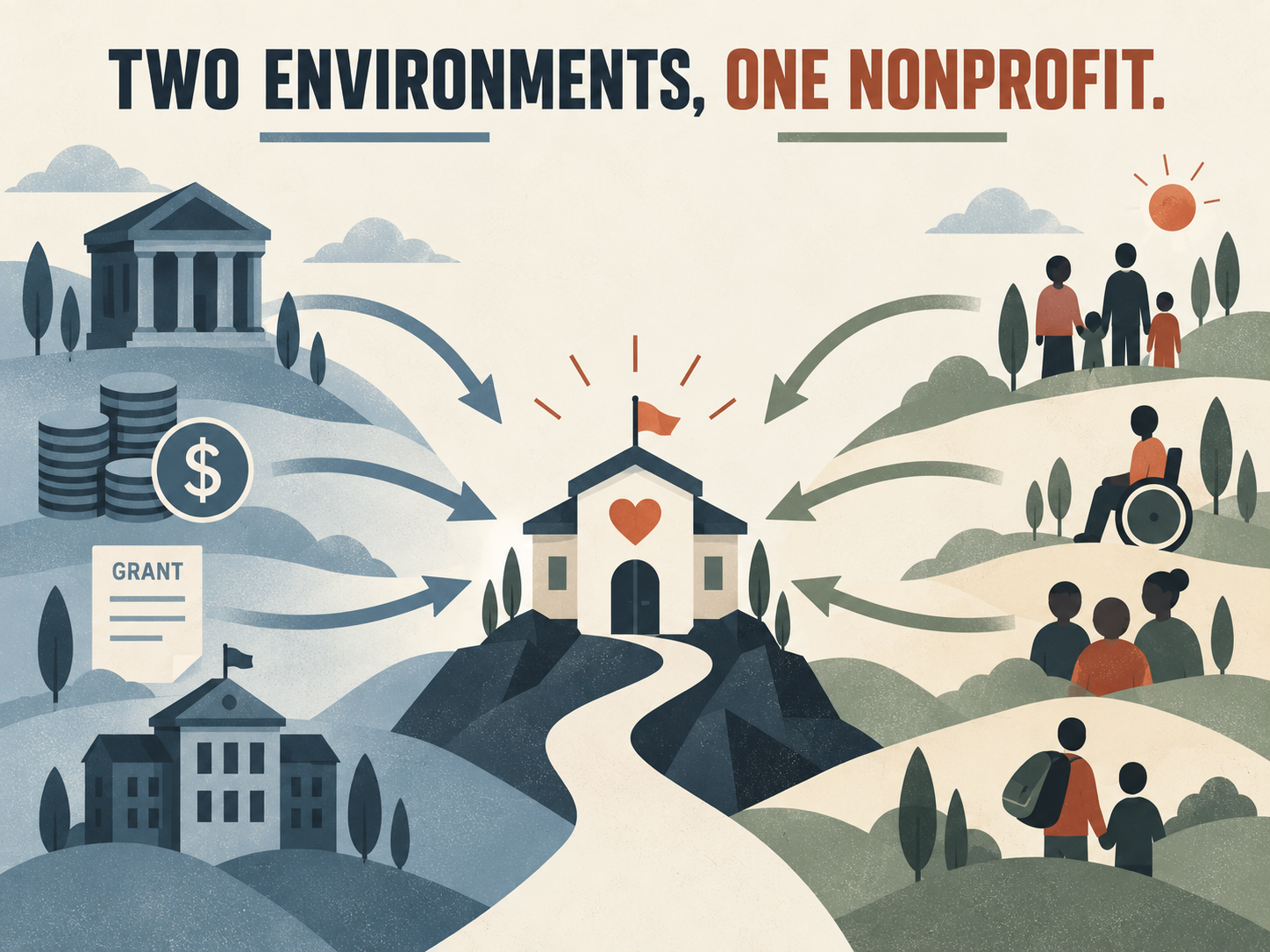
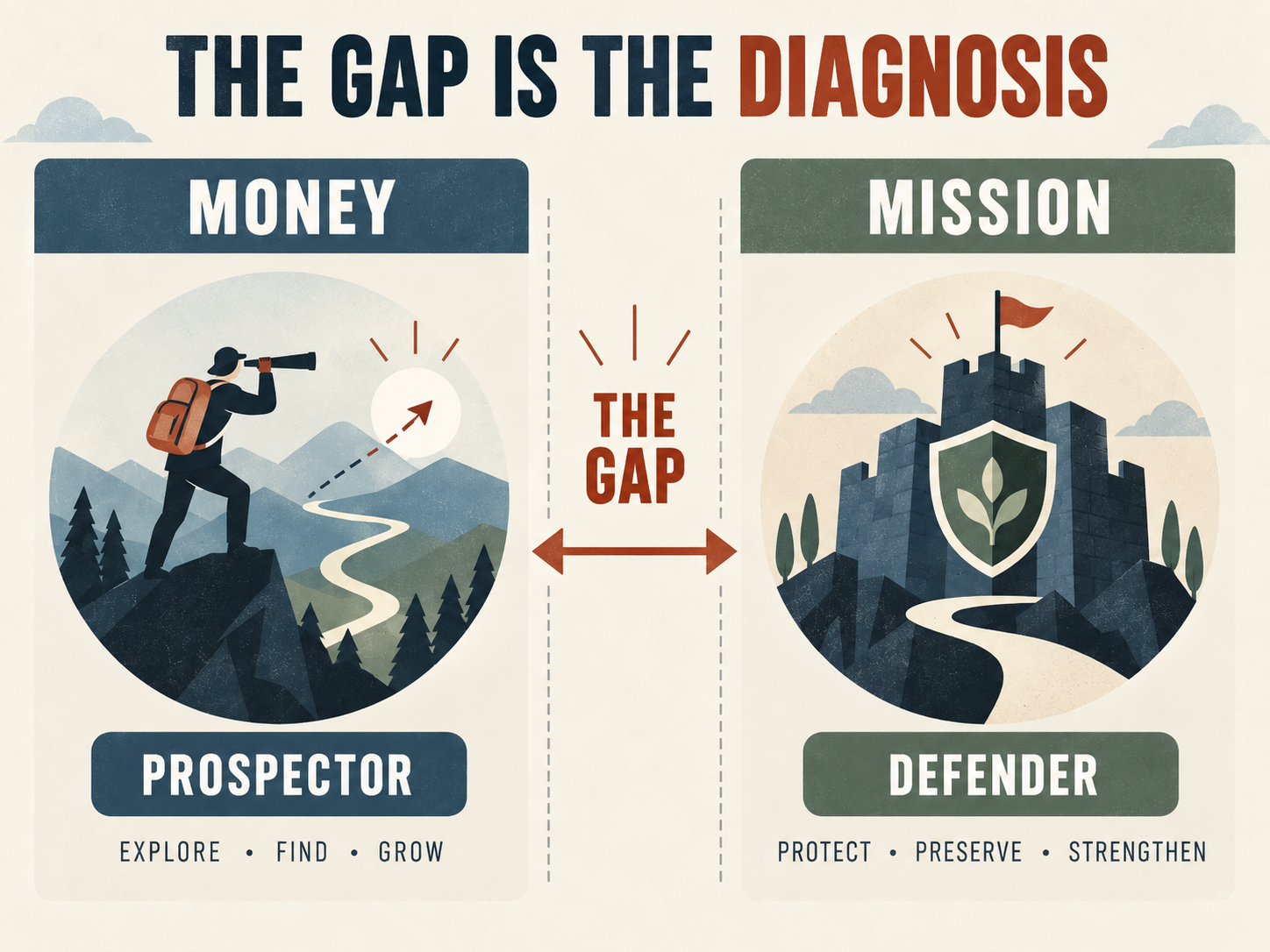
So you have to ask "what kind of nonprofit are you" twice: What is your posture toward money? What is your posture toward mission?
It changes the diagnosis. An organization prospecting hard for new funders while its core program thins is a prospector on paper and a reactor in practice. One that keeps declining grants that don't fit is a defender toward money and, if the community is steering the core, close to an analyzer toward mission. The for-profit typology sees one organization in each case. A nonprofit executive sees the gap between the columns, and the gap is the finding.
The nonprofit research has circled this for twenty years. Debra Minkoff and Walter Powell asked whether a mission shows constancy, responsiveness, or deflection, and what makes some organizations more vulnerable to outside influence. Kunle Akingbola tracked nonprofits moving between strategic types and found government funding doing the moving. William Brown and Joel Iverson sorted 132 nonprofits into the four types and found the board looked different in each. The vocabulary was borrowed from business. The problem is ours, and it has always had two sides.
NOBODY CHOOSES TO BE A REACTOR
Once you see two environments, you see that one is usually in charge.
Jeffrey Pfeffer and Gerald Salancik argued in 1978 that organizations are controlled by whoever controls the resources they cannot do without. For nonprofits, that means funders. Ann Goggins Gregory and Don Howard named the mechanism in 2009: the nonprofit starvation cycle, in which funders underpay for overhead, organizations underreport it to compete, and both learn that lean is normal. An organization with no reserves and twelve restricted grants cannot prospect; every dollar is already promised. It cannot defend, because the core is funded only as long as each funder's priorities include it. What is left is reaction, and the money column fills itself in.
That condition is not evenly distributed. The Building Movement Project's Race to Lead surveys, drawing on more than 4,000 nonprofit staff and executives, found that leaders of color report smaller budgets and more often lack access to individual donors (63 percent versus 49 percent for white leaders) and to foundations (51 percent versus 41 percent). Women of color were the most likely of any group to say race had hurt their careers, and the most likely to say gender had.
Read that against the typology and something uncomfortable appears. "Reactor" is a posture the funding system manufactures, then holds against the organizations it made. When a program officer calls a Black-led, community-rooted organization "unfocused," the honest question is who set the terms that made focus impossible.
Funders are reactors too. Foundations chase one another's priorities on three-year cycles, and the incoherence they diagnose in grantees is often their own.
WHO INHERITS A REACTOR
A second pattern concerns leaders rather than organizations.
The barriers facing women and people of color on the way to leadership are not in dispute. Women lead most of the sector's smallest nonprofits and under a third of its largest. Leaders of color report less access to the funders who control the money. Women of color report being passed over for people with comparable or lower credentials. That is the measured shape of the sector, not a hypothesis.
This post cares about what happens once they arrive. Alison Cook and Christy Glass analyzed fifteen years of Fortune 500 CEO transitions. They found white women, and men and women of color, more likely than white men to be promoted to lead weak firms, then replaced by white men when performance kept falling. They called it the savior effect. The Building Movement Project found executives of color who followed a white predecessor were less likely to feel trusted by their boards, 77 percent against 90 percent, in a report titled Trading Glass Ceilings for Glass Cliffs. And Ashleigh Shelby Rosette and Robert Livingston found, experimentally, that Black women leaders were judged more harshly than Black men or white women when their organization performed poorly.
Nobody has measured what happens when a queer woman of color succeeds a straight white man. Every layer above applies, and no one has studied the combination. That absence is a finding.
So the reactor posture is not only manufactured by funders. It is handed, disproportionately, to the leaders least likely to be forgiven for it. This post will not tell you to stop reacting. It will tell you to find out which column you are reacting in, and to get it on record before it is attributed to you.
THREE MOVES, SIZED TO HANDBACK
Marque's work runs on a short, defined scope that ends with the organization holding the tools. This diagnosis fits: two working sessions, and nothing you can't repeat without me.
Name both postures in one meeting. Put the four definitions in front of your leadership team and draw two columns, money and mission. For each, answer: where did the last three decisions in this column come from, inside or outside the organization? What have we stopped doing in the last three years? If our largest funder changed priorities tomorrow, would this column change, or just the budget? Most teams know within an hour. The gap between the columns is the diagnosis.
If you are a new executive, run this in your first ninety days and put the result in writing to the board. A posture documented on arrival is a condition you inherited. The same posture discovered a year later is a judgment about you. That matters most for the leaders the research above describes.
Separate two kinds of reaction. Reacting to funders is drift. Reacting to the people you serve is responsiveness, and it is the whole point. Rosa González's engagement spectrum from Post 1 applies here. If your program changed because participants held real decision-making power, that is not reaction. That is the mission column working as designed. Write down which recent pivots came from each environment. The ratio tells you which one is steering.

Decide what you will defend, then place one bet. Name the core in your plan and mark it protected, meaning it does not compete with new initiatives for resources during the plan. Then choose at most one prospector move, sized to the slack you actually have, the test from Post 1's third question. That is the ambidextrous posture, and for most organizations between $1 million and $10 million it is the realistic ambition. Then take it to your funders. Trust-based philanthropy exists because some funders now understand that multiyear, unrestricted money is what makes a mission column possible. Asking for it is a strategic act, not a fundraising one.
WHAT COMES NEXT
None of this works if the plan was never really the organization's. Post 3 takes the first question from Post 1 all the way down: who is your plan actually for, and what does it look like when the answer is the community. Post 4 tests the mission column, because "the community steered it" only counts if the community held real decision-making power, and most inclusive processes stop short of that. Post 5 returns to the leaders in this one, because the people most often handed an organization without slack are the ones blamed hardest when the stretch fails.
SOURCES
A note on links. Where a source is linked, you can read it for free. Where it isn't, it sits behind a journal paywall, and I'm not going to send you somewhere that charges you. The citation is complete enough to find through a library or a Google Scholar search, which often turns up an author-posted copy.
On strategic posture. Miles and Snow, Organizational Strategy, Structure, and Process, 1978. Andrews, Boyne, and Walker, "Strategy Content and Organizational Performance," Public Administration Review, 2006. Meier, O'Toole, Boyne, and Walker, "Strategic Management and the Performance of Public Organizations," Journal of Public Administration Research and Theory, 2007. Sollosy, Guidice, and Parboteeah, "Miles and Snow's Strategic Typology Redux Through the Lens of Ambidexterity," 2019.
On the nonprofit version of the problem. Minkoff and Powell, "Nonprofit Mission: Constancy, Responsiveness, or Deflection?" in The Nonprofit Sector: A Research Handbook, 2nd ed., Yale, 2006. Akingbola, "Strategic Choices and Change in Nonprofit Organizations," Strategic Change, 2006. Brown and Iverson, "Exploring Strategy and Board Structure in Nonprofit Organizations," Nonprofit and Voluntary Sector Quarterly, 2004. Pfeffer and Salancik, The External Control of Organizations, 1978. Goggins Gregory and Howard, "The Nonprofit Starvation Cycle," Stanford Social Innovation Review, 2009. For the money column specifically: Foster, Kim, and Christiansen, "Ten Nonprofit Funding Models," SSIR, 2009, and Bell, Masaoka, and Zimmerman, Nonprofit Sustainability, 2010.
On who leads under those conditions. Building Movement Project, Race to Lead (2017), Women of Color in the Nonprofit Sector (2019), Working at the Intersections (2018), and Trading Glass Ceilings for Glass Cliffs (2022), all free at racetolead.org. Cook and Glass, "Above the Glass Ceiling," Strategic Management Journal, 2014. Morgenroth, Kirby, Ryan, and Sudkämper, "The Who, When, and Why of the Glass Cliff Phenomenon," Psychological Bulletin, 2020, university repository copy. Rosette and Livingston, "Failure Is Not an Option for Black Women," Journal of Experimental Social Psychology, 2012, posted by the author; a two-paragraph summary is at Harvard Kennedy School's Gender Action Portal.
On the alternative. Rosa González, The Spectrum of Community Engagement to Ownership, 2019. Trust-Based Philanthropy Project.
Caveats that carry over from Post 1: the two performance studies are correlational and examine public agencies. Cook and Glass studied corporations; a 2020 meta-analysis of the glass cliff literature is included above for readers who want the full picture. Race to Lead is self-reported survey data. The two-column reading of the typology is my synthesis of the nonprofit research above, not a published framework. I cite everything as it is.

About the author
Andy Rathmann-Noonan
Founder, Marque Nonprofit Advisors
I work with one organization at a time. Executive directors call me when growth, a leadership change, or a funding shift has outrun the way the organization is built. I diagnose what is actually load bearing, scope the work, build the fix, and hand it back. No retainer that never ends.
Last updated October 5, 2026.