The short answer
Most strategic plans are written for a funder, and most organizations will not say so. That is the problem, not the plan. A plan built for a funder has one job: prove, in a few pages, that money you give this organization becomes impact you can see. Build that document honestly, in three weeks, with the eight sections below, and it will do more work than the binder. Pretend it is something else and you get the shelf.
My first post in this strategic planning series argued that four questions decide whether a plan gets used, and the first is: who is this strategic plan actually for? I gave it two paragraphs. It needs a post, because the honest answer is one nobody likes saying out loud.
The plan is for a funder.

Not for the staff, who will not read it. Not for the board, who will approve it and move on. For a program officer or a trustee with a stack of applications and one question: should we give these people money? This post is about building that plan well and offers a template to help organize your thoughts.
What the plan is being asked to do
Hwang and Bromley's study from Post 1 found that among 200 Bay Area nonprofits, having a formal plan was predicted as much by ties to funders as by need. Plans exist because the people with money expect them.
That is not cynical. A funder cannot visit every organization. The plan is a proxy for a site visit, and the question it answers is not "what is your strategy" but "can these people be trusted with money." The honest version says: here is what we do, what it costs, what happens if you fund it, and how you will know. And it says it fast, because the reader has forty others.
What the person reading the stack actually looks at
I sit on the grants committee of a family foundation. I do not read a strategic plan front to back. I look for four things, in this order.
The line from money to impact. Can I trace a dollar from the grant to the person it was meant to reach, in one sentence? Of every dollar raised, this much went to programs, this much reached participants, this is what it produced. If the plan makes me do that math, I assume the organization has not done it either.

A clear-eyed account of where the organization actually is. Its real position in the community it serves, backed by numbers it did not choose because they flattered it. The plans I trust name a weakness before I find one.
Evidence that someone is counting, and someone is listening. Not the number itself but the habit behind it; a single impressive statistic from three years ago tells me more than it intends. And participant voices, in their words. An organization that can count and can hear.
Everything else, the vision language, the pillars, I skim. Those pages are for the board.
Funders are, slowly, asking for less. The Center for Effective Philanthropy found the median time spent on a single funder's proposal fell from 20 hours before 2020 to 15 after, and PEAK Grantmaking now asks funders to keep requirements proportional to the amount requested. Most organizations still live outside that. The plan still gets asked for. Build it to do its job in two pages.
The eight sections
Each answers a question the committee is already asking.
1. Mission and vision. What you do and what the world looks like if you succeed. Six sentences, at most.
2. Origin. Why this organization exists, in the words of whoever started it or runs it. No, the research on giving is consistent: people respond more to a specific story than to a statistic. True in 150 words beats polished in 500.
3. Theory of change. We do this, which produces this, which leads to this. Three steps, each one testable. It separates organizations that understand their work from ones that describe it.
4. The key program. The one that carries the mission, in enough detail that a funder could picture a Tuesday: who shows up, what happens, what it costs per participant.
5. Funding needs and the organization behind them. What it costs to run as it is, where the money comes from, where it is thin, and who does the work, including the one role you are missing. Funders are deciding whether to trust people, not programs.
6. What funding unlocks. The section most plans skip, and the one funders read first. With this money, X. With this much more, Y. What stays undone without it.
7. Goals, and how you will know. Three short-term (inside the grant period) and three long-term. Every goal has an owner and a number, and the section ends with how you count the numbered goals. The habit, not just the target.
8. The ask. A dollar amount, a purpose, what happens next. Not "support our mission."
Eight pages at most, with a one-page brief up front for the trustee who reads only that. The brief is what gets forwarded.
Three weeks is enough. The executive director writes one through four, the finance lead writes five and six, a program director checks four against reality, and the board approves it. Nobody holds a retreat. Dana O'Donovan and Noah Rimland Flower argued in Stanford Social Innovation Review over a decade ago that the long, episodic plan was already dead. Three weeks and a yearly refresh is closer to what they described than nine months and a binder.

Where this comes from. This is not a standard strategic plan, and I will not pretend it is. Half is the case for support fundraisers have been taught since Harold Seymour wrote it down in 1966: purpose, program, need, the ask. The other half is what funders say a plan should contain. The New Hampshire Charitable Foundation publishes a guide to what it expects when an applicant attaches a plan, and the overlap is close: vision, mission, quantitative goals, named owners, monitoring. Bridgespan's four questions from a 2008 Harvard Business Review article cover the rest; sections three, five, six, and seven are those questions in order. What is missing on purpose is the situational analysis most templates open with. The New Hampshire guide says that organizations should right-size the effort. The analysis belongs in the internal plan; a funder needs the conclusion, not the work.
Two plans I have lived with
The first was a small organization, under a million dollars, where I was the executive. We revamped the mission and needed goals through 2030. The plan was short, honest about what we could not yet afford, and the "what funding unlocks" section carried every proposal for years after. It was a funder plan. It never went on a shelf, because we kept pulling pages out of it.

The second I inherited: a larger organization, well into the eight figures, with a plan built because the board wanted one, by the board and executive team alone. Nobody below the executive level had touched it, and nobody below it used it. It had an audience of about twelve people, and they had already read it. The first plan knew its audience. The second was for the board's comfort.
Where it goes wrong
Pretending. Building a funder plan with a participatory process designed for an internal one. Forty staff in a retreat for a document that was always going to be eight pages for a program officer. People ask for input that visibly doesn't matter and end up less committed than if they never asked. Build it with the four people it takes.
Letting the approvers write the measures. Jara Dean-Coffey's point from Post 1 lands hardest here. A funder plan's outcomes are written by the people who approve it, for the people who fund it. The people served rarely get a vote on what counts. Before you write section seven, ask ten participants what a good year would look like for them, and put one answer in the plan as a measure. It will be the most credible number in the document. Fund for Shared Insight's Listen4Good has free tools.

Craftsmanship. A funder plan is a proxy for the organization, and inconsistent numbers read as evidence about how the place is run. Have someone who didn't write it check every number against the budget.
All of this aside, if you are a small nonprofit where you, as the executive, are also the program staff and maybe even the finance lead, I recommend engaging an external advisor for feedback. The group that helps develop this must be hand-picked. Still, if the group is only you, as in smaller nonprofit settings, you must reach outside your ecosystem and bring in experts/advisors who can help shape, proofread, and offer critical assessments.
And while your board might seem like a logical community to tap into, it may create an expectation for a deliverable you don't have time to develop or need to deliver, yet: a strategic plan mandated by the board.
The thing nobody tells you
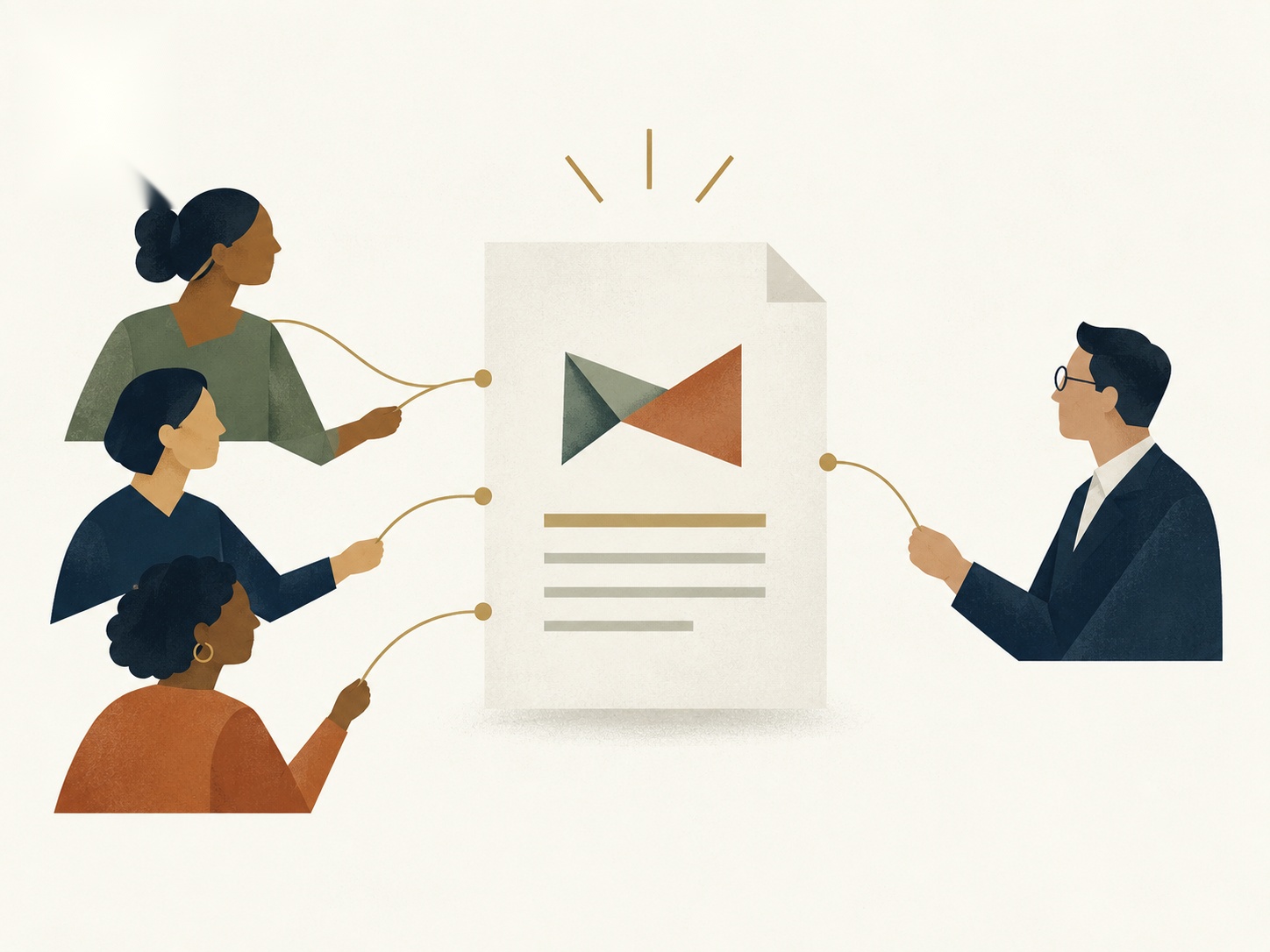
A funder plan and a real plan can be the same document. Usually they aren't, because four people (or fewer) built the funder plan in three weeks, and the real plan needs the people who will carry it. But the eight sections are the skeleton of any plan worth having; the difference is who writes them. If the people you serve wrote section seven and your program directors own the goals, the funder plan stops being a proxy and becomes a description of an organization that works. Getting there without faking it is the next post.
What I would do with it
Marque's work is a defined scope that ends with the organization holding the tools. For a funder plan, most of the value is knowing which plan you are building before you start. If you want to talk through which one you need, that is a conversation, not a sales call. The organizational health assessment is a reasonable place to start if you would rather look first.
You can access the one-page brief here. One person, one afternoon. Yours.
What comes next
A conversation with Candace Smith, CEO of the Washington Tennis & Education Foundation, about how WTEF built the plan it published this fall. Then Post 4.
SOURCES
A note on links. Where a source is linked, you can read it for free. Where it isn't, it sits behind a journal paywall, and I'm not going to send you somewhere that charges you. The citation is complete enough to find through a library or a Google Scholar search, which often turns up an author-posted copy.
On what a funder-facing plan should contain. New Hampshire Charitable Foundation, Strategic Plans, the foundation's own guide to the components it expects when a plan accompanies an application. Bradach, Tierney, and Stone, "Delivering on the Promise of Nonprofits," Harvard Business Review, 2008, free from Bridgespan. Seymour, Designs for Fund-Raising, 1966, the origin of the support case, taught since 1974 by The Fund Raising School at Indiana University's Lilly Family School of Philanthropy. O'Donovan and Rimland Flower, "The Strategic Plan Is Dead. Long Live Strategy," Stanford Social Innovation Review, 2013. National Council of Nonprofits Strategic Planning for Nonprofits
On why plans get asked for. Hwang and Bromley, "Internal and External Determinants of Formal Plans in the Nonprofit Sector"; Meyer and Rowan, "Institutionalized Organizations: Formal Structure as Myth and Ceremony," American Journal of Sociology, 1977. Sara Ahmed, "'You End Up Doing the Document Rather than Doing the Doing,'" Ethnic and Racial Studies, 2007.
On what funders are asking for now. Center for Effective Philanthropy, State of Nonprofits2023: What Funders Need to Know and State of Nonprofits2024. PEAK Grantmaking, Principles for Peak Grantmaking, including Narrow the Power Gap and Drive Equity. Trust-Based Philanthropy Project.
On whose measures count. Jara Dean-Coffey, "What's Race Got to Do With It? Equity and Philanthropic Evaluation Practice," American Journal of Evaluation, 2018. See also the Equitable Evaluation Framework. Fund for Shared Insight, Listen4Good, on constituent feedback practice. On giving and stories, Small, Loewenstein, and Slovic, "Sympathy and Callousness: The Impact of Deliberative Thought on Donations to Identifiable and Statistical Victims," Organizational Behavior and Human Decision Processes, 2007.
On process fairness. Korsgaard, Sapienza, and Schweiger, "Beaten Before Begun: The Role of Procedural Justice in Planning Change," Journal of Management, 2002.
My observations of grant committees are my own, from one family foundation. They are one reader's habits, not a survey of funders. I use the eight-section structure. It is a hybrid of the case for support and the components funders and Bridgespan describe, and the post says where it departs from both.
About the author
Andy Rathmann-Noonan
Founder, Marque Nonprofit Advisors
I work with one organization at a time. Executive directors call me when growth, a leadership change, or a funding shift has outrun the way the organization is built. I diagnose what is actually load bearing, scope the work, build the fix, and hand it back. No retainer that never ends.
Last updated October 12, 2026.