The short answer
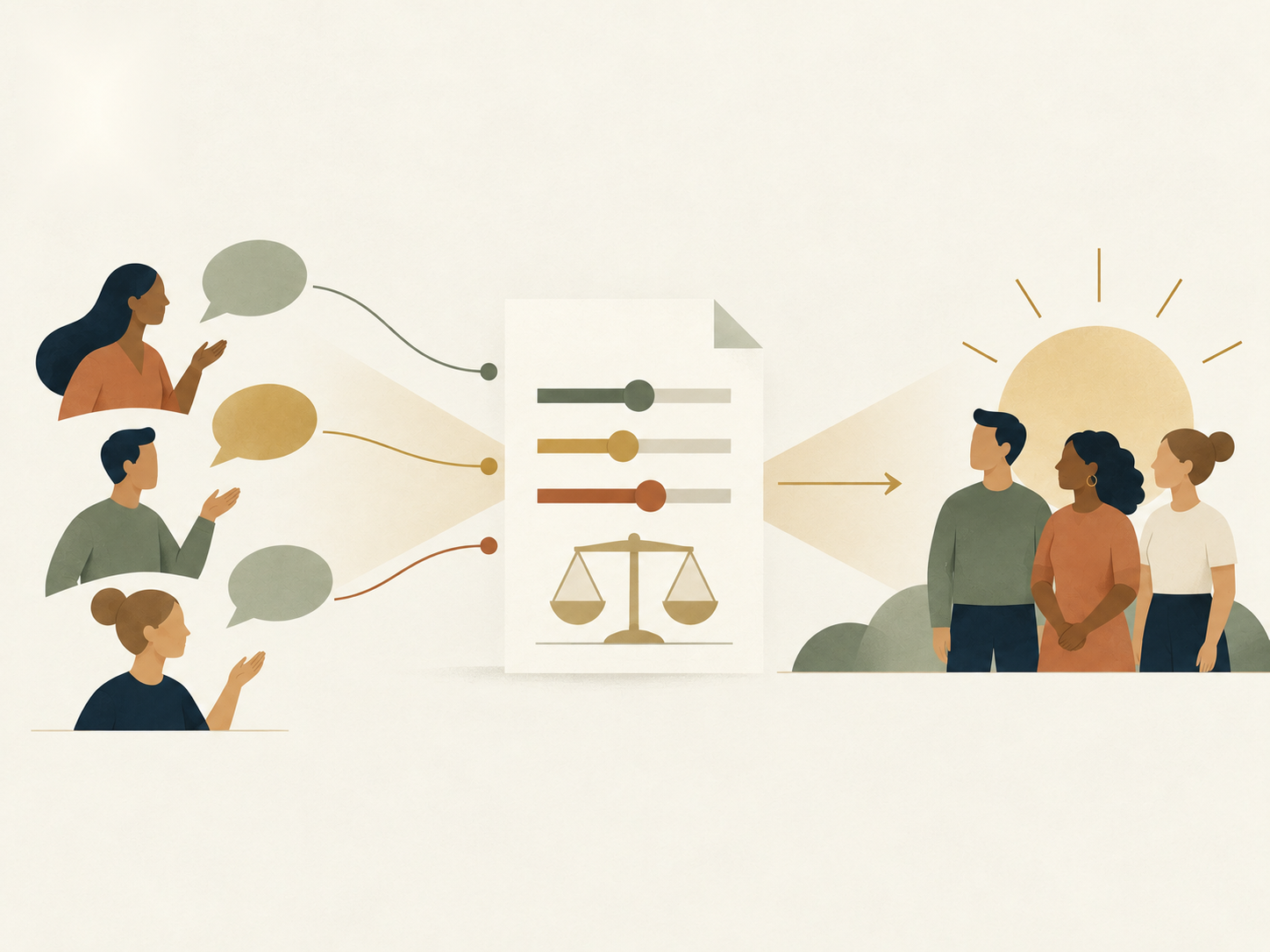
Asking people for input makes them more committed to a decision, even one that goes against them, under two conditions: you asked before the decision was made, and they can see their input was weighed. Break either one and asking becomes worse than not asking. The fix is to name, in advance and out loud, which decisions are open, which are consultative, and which are already made. The Management Center publishes free tools for exactly this. The hardest audience for that conversation is usually your board, and the executive director has to have it before the first planning session, not after.
In Post 1, I wrote that participation theater is worse than a small, inclusive strategic planning process, and that if you are not prepared to let what people say change the outcome, you should not ask. I still believe that. But it is half the story.
Picture the retreat. Forty staff on a Friday, three walls of sticky notes, dot voting. Everyone leaves tired and a little hopeful. Six weeks later, the plan arrives looking like the draft leadership showed the board in the spring. Nobody says that out loud. Nobody has to.
I have facilitated a version of that day. The question I should have asked beforehand was not how to get more voices in the room. It was what the room was allowed to decide.
What the research actually says
The study of voice in decision-making goes back to John Thibaut and Laurens Walker, who in 1975 found that people judged a legal process as fairer and accepted its outcome more readily when they could present their side. Not when they won. When they were heard. Robert Folger called it the fair process effect: give people a voice, and they rate the decision as fairer and live with it more willingly, even when it goes against them.
That is the finding I underweighted in Post 1. Asking usually helps, especially for people who lose.
Then there are the two ways it flips.
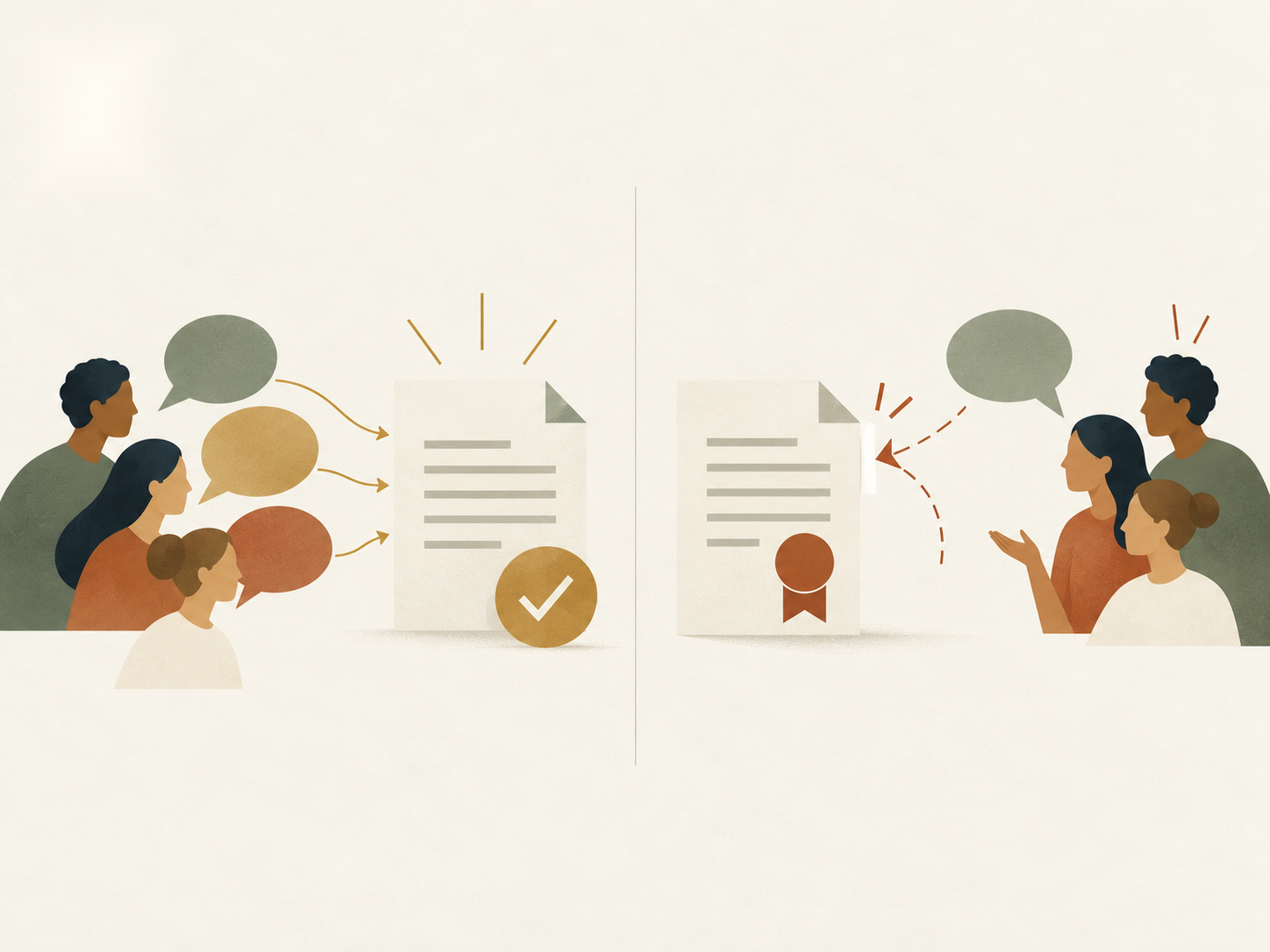
The first is timing. Allan Lind, Ruth Kanfer, and Christopher Earley ran an experiment in 1990 where some people gave input before a decision and others after it was already made. Pre-decision voice raised perceptions of fairness the most. Post-decision voice helped a little, but much less, and people could tell the difference. If the draft exists before the retreat, the retreat is post-decision voice wearing a pre-decision costume.

The second is visibility. Folger and his colleagues documented the frustration effect: when people are given voice and then see clear evidence it was disregarded, they rate the process as less fair than people never asked at all. The lab evidence for that is thinner than for the fair process effect, but it holds up in workplaces. Gerdien de Vries, Karen Jehn, and Bart Terwel studied what they call pseudo voice, managers who ask for input with no intention of using it, and found employees stopped offering ideas and team conflict went up. Audrey Korsgaard's work on management teams, cited in Post 1, found the same mechanism. Attendance didn't produce commitment; it was believing your input was considered and hearing why it was or wasn't.
So the rule is three parts. Ask before you decide. Show that you weighed it. When you do not take it, say so and say why.
Two newer findings sharpen it. Taeya Howell and colleagues followed 693 employees across 89 credit union units and found that supervisors gave more credit for the same amount of speaking up to employees of the majority ethnicity, and that speaking up more did not close the gap. Joel Brockner's team, with samples in the United States, Germany, China, Mexico, and Hong Kong, found the voice effect weakens where people expect hierarchy, and a later analysis of 190,000 employees in 32 countries confirmed this. If your staff and community span cultures and languages, consult mode is not level ground unless you make it so, and silence is not consent.
One warning the field has issued about itself. Because fair process helps people accept decisions that go against them, it can manufacture acceptance of bad ones. Critics of procedural justice in policing say exactly that. What follows is not a technique for getting staff to swallow a decision already made. If that is the goal, run tell mode and own it.
Two of mine
The first was a public statement during a hard moment for the field. I wrote it alone, the staff believed in it, and I was proud of it. Then I shopped it to the board near the deadline, and the board overruled it. There were no feedback loops. I had not told the board when they would see it or what their role was, or told the staff that the board could stop it. The statement was never released. The staff learned that leadership's words could vanish, and the board learned that I brought them finished products. Everybody was asked, in a sense. Nobody had been told what the asking was for. That is theater, and I staged it.
The second went the other way. During a mission and vision refresh, I wanted equity language that made part of the board uncomfortable. The board had real input, and I heard it. Then I overrode them. But I made it clear from the start that the mission language was a leadership recommendation the board would vote on; I explained why I was holding the line, and I gave members who disagreed time, readings, and conversations with people who could speak to the language from experience. The language went in. Some board members still disagreed. None felt ambushed.
Procedural justice is not majority rule. It is the absence of a surprise about who decides.
Say the mode before you ask
The practical tool here already exists, and it is free. The Management Center, which builds management practice for social justice organizations, publishes a short piece on five decision-making modes: tell, persuade, test, consult, and joint. No mode is better than another. The point is that you announce the mode before you open the floor. "I have decided and here is why" is legitimate. "I have a draft and want to pressure test it" is legitimate. "This is open, and we are deciding together" is legitimate. Trust breaks down when you run one mode while implying another.
The same site publishes MOCHA, a role tool that names, for any piece of work, the Manager, the Owner, who is Consulted, who Helps, and who Approves. In strategic planning, the board is almost always the approver, which is appropriate. It becomes a problem only when it's unspoken, because then every staff member who contributed thinks they were part of a joint decision and learns at the end that they were consulted.
Two frameworks say the same thing from the community side. Sherry Arnstein's 1969 ladder of citizen participation was written about urban renewal, specifically Black residents invited to hearings on demolitions already scheduled. She called those rungs tokenism; the invitation itself was the harm. Later scholars fault the ladder for treating more control as always better; Rosa González's Spectrum of Community Engagement to Ownership is the better working map. If you can place your process on it, you can say the mode. If not, you are about to run theater.
The wedge
In BoardSource's most recent full Leading with Intent report, 49 percent of executives said they lacked the right board members to build trust with the communities they serve, and 67 percent said their board spent too little time on community relationships. Seventy-eight percent of board members were white, and about one board in five had no people of color at all. The board is not the enemy. It is the one body with a thirty-thousand-foot view, and a plan built without that view runs out of money in year two.
But the board is also, structurally, the approver furthest from the work and least likely to have been in the room when input was gathered. That is the wedge. Staff gives input in consult mode. The board decides in tell mode. Nobody said either out loud, and the executive director is standing in the gap when the plan comes back changed.

You cannot avoid the wedge. You can only get in front of it. Some of the hardest work an executive director will do in a planning process is pitching the board on the process itself, before the first staff session: here are the decisions, the mode for each, where you approve, where you are consulted, and when staff will hear what happened and why. It fits on one page. It is uncomfortable to present. It is also the most protective thing you can do for the staff about to spend a Friday on sticky notes.
If you are staff
Three questions, asked politely, before the retreat:
- What decision is this input for?
- What mode are we in?
- When will we hear what happened to it?
If leadership can answer those, give everything you have. If not, your input isn't wasted. It is being spent, and you deserve to know what it is buying.

What I would do with it
The tools are free and linked below, and most organizations can run this without me. Where Marque helps is the board piece: building the decision sheet with the executive director and getting the board to agree to it before the staff process starts. Scoped, time-bound, built to be handed back. If you want that, let's talk. If not, start with the Management Center pages.
What comes next
Post 5. Stretch Goals Require Slack You Do Not Have. Ambition, capacity, and why the year after a deficit is the worst possible moment for a bold plan.
Sources
Where a source is linked, you can read it for free. Where it isn't, it sits behind a journal paywall, and I'm not going to send you somewhere that charges you.
Voice and the fair process effect
Thibaut, J., & Walker, L. (1975). Procedural Justice: A Psychological Analysis. Lawrence Erlbaum.
Folger, R. (1977). Distributive and Procedural Justice: Combined Impact of "Voice" and Improvement on Experienced Inequity. Journal of Personality and Social Psychology, 35(2), 108 to 119.
Folger, R., Rosenfield, D., Grove, J., & Corkran, L. (1979). Effects of "Voice" and Peer Opinions on Responses to Inequity. Journal of Personality and Social Psychology, 37(12), 2253 to 2261.
Lind, E. A., Kanfer, R., & Earley, P. C. (1990). Voice, Control, and Procedural Justice: Instrumental and Noninstrumental Concerns in Fairness Judgments. Journal of Personality and Social Psychology, 59(5), 952 to 959.
Korsgaard, M. A., Schweiger, D. M., & Sapienza, H. J. (1995). Building Commitment, Attachment, and Trust in Strategic Decision-Making Teams. Academy of Management Journal, 38(1), 60 to 84.
de Vries, G., Jehn, K. A., & Terwel, B. W. (2012). When Employees Stop Talking and Start Fighting: The Detrimental Effects of Pseudo Voice in Organizations. Journal of Business Ethics, 105(2), 221 to 230.
Whose voice counts, and where
Howell, T. M., Harrison, D. A., Burris, E. R., & Detert, J. R. (2015). Who Gets Credit for Input? Demographic and Structural Status Cues in Voice Recognition. Journal of Applied Psychology, 100(6), 1765 to 1784. Free author copy: https://scholarsarchive.byu.edu/facpub/9845/
Brockner, J., Ackerman, G., Greenberg, J., Gelfand, M. J., et al. (2001). Culture and Procedural Justice: The Influence of Power Distance on Reactions to Voice. Journal of Experimental Social Psychology, 37(4), 300 to 315.
Shao, R., Rupp, D. E., Skarlicki, D. P., & Jones, K. S. (2013). Employee Justice Across Cultures: A Meta-Analytic Review. Journal of Management, 39(1), 263 to 301.
MacCoun, R. J. (2005). Voice, Control, and Belonging: The Double-Edged Sword of Procedural Fairness. Annual Review of Law and Social Science, 1, 171 to 201. Free: https://gspp.berkeley.edu/assets/uploads/research/pdf/MacCoun_ARLSS2005.pdf
Naming the mode
The Management Center. Modes of Decision-Making. https://www.managementcenter.org/resources/modes-decision-making/
The Management Center. MOCHA: Assigning Responsibilities. https://www.managementcenter.org/resources/assigning-responsibilities/
González, R. (2019). The Spectrum of Community Engagement to Ownership. Facilitating Power and Movement Strategy Center. https://movementstrategy.org/resources/the-spectrum-of-community-engagement-to-ownership/
Arnstein, S. R. (1969). A Ladder of Citizen Participation. Journal of the American Institute of Planners, 35(4), 216 to 224. Free reprint: https://www.participatorymethods.org/sites/participatorymethods.org/files/Arnstein%20ladder%201969.pdf
Tritter, J. Q., & McCallum, A. (2006). The Snakes and Ladders of User Involvement: Moving Beyond Arnstein. Health Policy, 76(2), 156 to 168.
Cooke, B., & Kothari, U. (Eds.). (2001). Participation: The New Tyranny? Zed Books.
Boards
BoardSource. (2021). Leading with Intent: BoardSource Index of Nonprofit Board Practices. https://leadingwithintent.org/
BoardSource. (2021). Leading with Intent: Reviewing the State of Diversity, Equity, and Inclusion on Nonprofit Boards. https://leadingwithintent.org/wp-content/uploads/2021/06/2021-Leading-with-Intent-Report.pdf
Two caveats. The frustration effect shows up less consistently in experiments than the fair process effect, which is why I lean on workplace studies for it. And BoardSource's 2021 report is the last full edition; its 2023 survey data is being released as briefs and dashboards, and the composition numbers may have moved.
Last updated October 22, 2026.